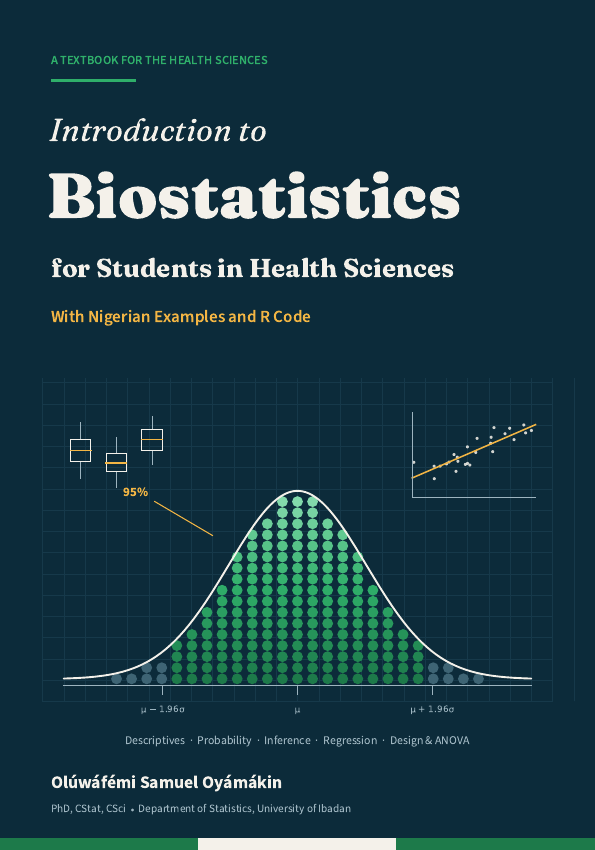
Introduction to Biostatistics
For Students in Health Sciences
Descriptive statistics, probability, inference, regression, experimental design and ANOVA, with Nigerian examples and R code.
Statistical understanding, applied computing and research practice
SciLab supports statistical learning for researchers and institutions. Training enquiries can focus on statistical programming, research design, data analysis, modelling or the interpretation and communication of results.
Courses taught by Dr Oluwafemi Samuel Oyamakin, with complete chapter readings, worked examples, exercises and downloadable textbooks for the three courses below. Introduction to Biostatistics is available for enquiries.
For Students in Health Sciences
Descriptive statistics, probability, inference, regression, experimental design and ANOVA, with Nigerian examples and R code.
Foundations and applications to Nigerian health systems
Statistical inference, machine learning and infectious disease modelling, supported by worked examples and mini-projects.
18 chapters · Complete textbook and answer key
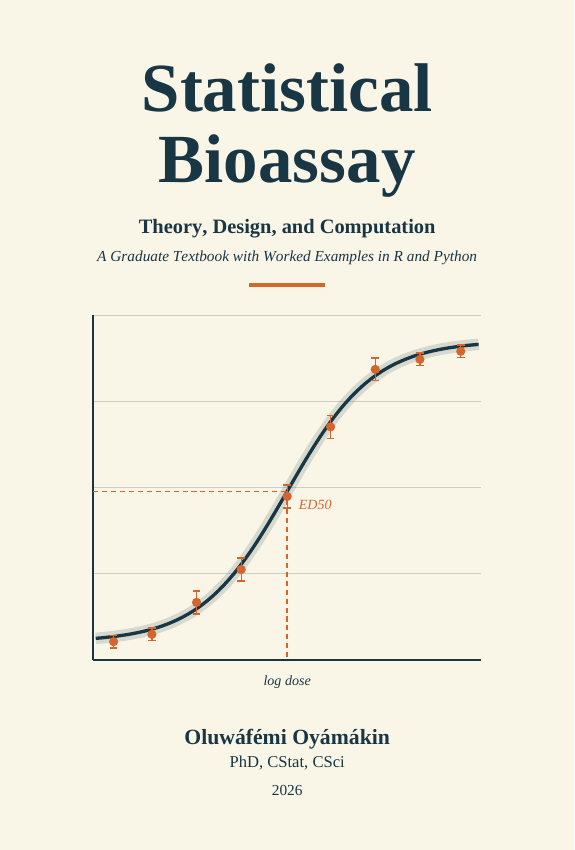
Theory, Design, and Computation
A graduate-level course supported by a textbook with worked examples in R and Python.
12 chapters · Complete textbook and answer key
Theory, Practice and Application
Statistical genetics through its theoretical foundations, practical methods and applications.
20 chapters · Complete textbook and answer key
Counting techniques, probability laws, random variables and distributions, taught through fifteen lectures with equations, worked examples and revision questions.
| Area | Focus |
|---|---|
| Statistical reasoning | Probability, distributions, inference and interpretation |
| R and applied analysis | Data preparation, visualisation, regression and diagnostics |
| Research methods | Study design, sampling and analytical planning |
| Biostatistics | Health research, survival analysis and biological modelling |
| Reproducible reporting | Clear methods, documented analysis and mathematical typesetting |
The July 2026 CV records the following training and workshop contributions.
| Year | Contribution | Context |
|---|---|---|
| 2023 | Biobanking data management strategies | Resource person, Global Emerging Pathogens Treatment Consortium |
| 2021 | Modelling biological concepts with hands-on LaTeX | Royal Statistical Society, Nigeria Local Group |
| 2016 | Logistic regression modelling and diagnostics using R | Facilitator, University of Ibadan Laboratory for Interdisciplinary Statistical Analysis |
Participation in the DSI-Africa short-course series includes health data science (2022), machine learning (2023), deep learning (2023), and climate change, food systems and planetary health (2024), with the University of KwaZulu-Natal, Harvard T.H. Chan School of Public Health and Heidelberg University.
Further development includes the CODATA-RDA School of Research Data Science and the CIMPA School on Mathematical and Statistical Methods for Data Sciences in 2022. The CV records completion of the Nigeria Malaria Modelling Fellowship with Corona Management Systems in May 2026.
STA 211: Probability II provides the full fifteen-lecture teaching guide, worked examples and revision material.