Probability Laws
STA 211 · Lecture 03
Introduction
A probability model is a triple consisting of a sample space, a collection of events and a probability measure. The axioms are few, but they generate the principal laws used throughout probability and statistics.
Learning Objectives
You should be able to:
- define a sample space, event and probability measure;
- state and apply the probability axioms;
- use complement, addition and inclusion-exclusion laws;
- apply De Morgan’s laws; and
- distinguish mutually exclusive and exhaustive events.
Pre-Test
- What is the sample space for two tosses of a coin?
- Can two events overlap and still be distinct?
Views of Probability
Three common interpretations are useful:
- Classical: based on equally likely outcomes.
- Relative-frequency: probability is the long-run proportion of occurrence in repeated trials.
- Subjective or Bayesian: probability represents a coherent degree of belief, updated when evidence becomes available.
The mathematical laws are the same once probabilities have been assigned.
Axioms of Probability
For every event :
- Non-negativity: .
- Normalisation: .
- Countable additivity: if are pairwise disjoint, then
Immediate Consequences
The impossible event has probability zero:
The complement rule is
If , then
For any events and ,
Addition Law and Inclusion-Exclusion
For two events,
The subtraction is required because outcomes in are included twice in .
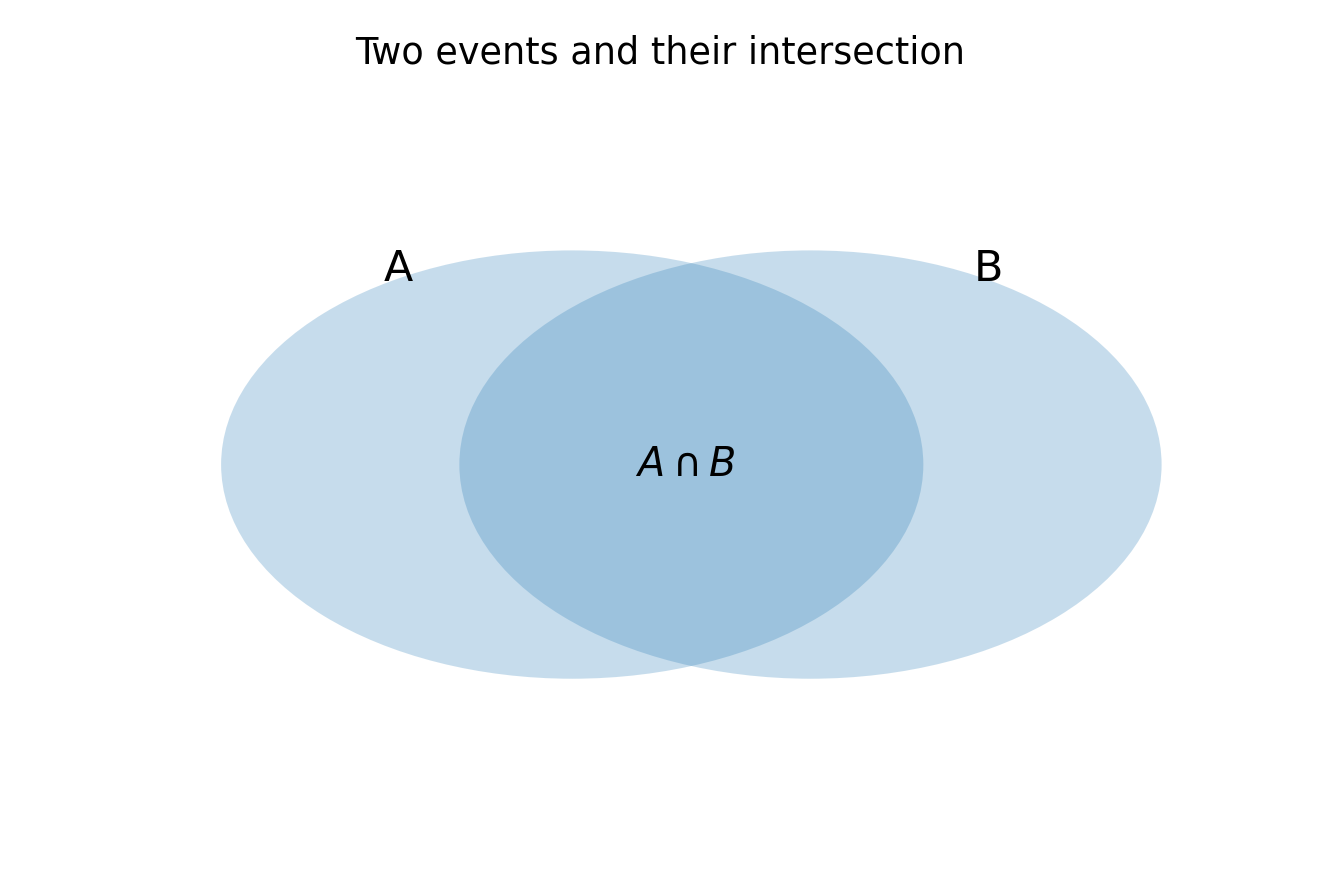
Two events and their intersection
For three events,
Example 3.1: Survey responses
In a survey, 60% use mobile banking, 45% use internet banking and 30% use both. The probability that a randomly selected respondent uses at least one service is
The probability of using neither service is
De Morgan’s Laws
The complements of unions and intersections satisfy
Thus, “not at least one” means “none”, and “not both” means “at least one fails”.
Example 3.2: At least one success
If independent trials have success probability on trial , the probability of at least one success is often easiest to calculate by the complement:
For four fair die rolls, the probability of at least one six is
Mutually Exclusive and Exhaustive Events
Events are mutually exclusive if
A collection is exhaustive if
A mutually exclusive and exhaustive collection forms a partition of the sample space.
Common Errors
- Adding and without subtracting the overlap.
- Confusing “mutually exclusive” with “independent”.
- Assuming outcomes are equally likely without justification.
- Treating as before independence has been established.
Post-Test
- If , and , find .
- If , and , find .
- State the three-event inclusion-exclusion formula.
- A fair coin is tossed five times. Find the probability of at least one head.
- If , explain why .
Selected answers: 1. ; 2. ; 4. .