Conditional Probability, Independence and Bayes’ Rule
STA 211 · Lecture 04
Introduction
Conditional probability revises the probability of an event when additional information is available. It is the foundation of diagnostic testing, classification, reliability analysis, risk assessment and Bayesian inference.
Learning Objectives
You should be able to:
- calculate conditional probabilities;
- use multiplication and chain rules;
- test event independence;
- apply the law of total probability; and
- use Bayes’ theorem to reverse conditioning.
Pre-Test
- What does represent?
- If a card is drawn from a standard deck and is known to be red, how many possible cards remain?
Conditional Probability
For events and with ,
Conditioning restricts the sample space to and then measures the proportion of that also lies in .
Example 4.1: Two coin tosses
A fair coin is tossed twice. Given that at least one head occurred, find the probability that the second toss was a head.
The restricted outcomes are . Two of these have a head on the second toss, so
Multiplication and Chain Rules
Rearranging the definition gives
For three events,
More generally,
Example 4.2: Sampling without replacement
A box contains 10 red and 10 green balls. Three balls are drawn without replacement. The probability that all are red is
Independence
Events and are independent if
When , this is equivalent to
Independence means that knowledge of one event does not alter the probability of the other.
Mutual versus pairwise independence
Events are mutually independent if all pairwise factorisations hold and
Pairwise independence alone does not guarantee mutual independence.
Mutually exclusive is not independent
If and are mutually exclusive with positive probabilities, then but . Therefore, they are dependent.
Probability Trees
A tree diagram makes sequential conditioning explicit. Probabilities multiply along a path and add across mutually exclusive paths.
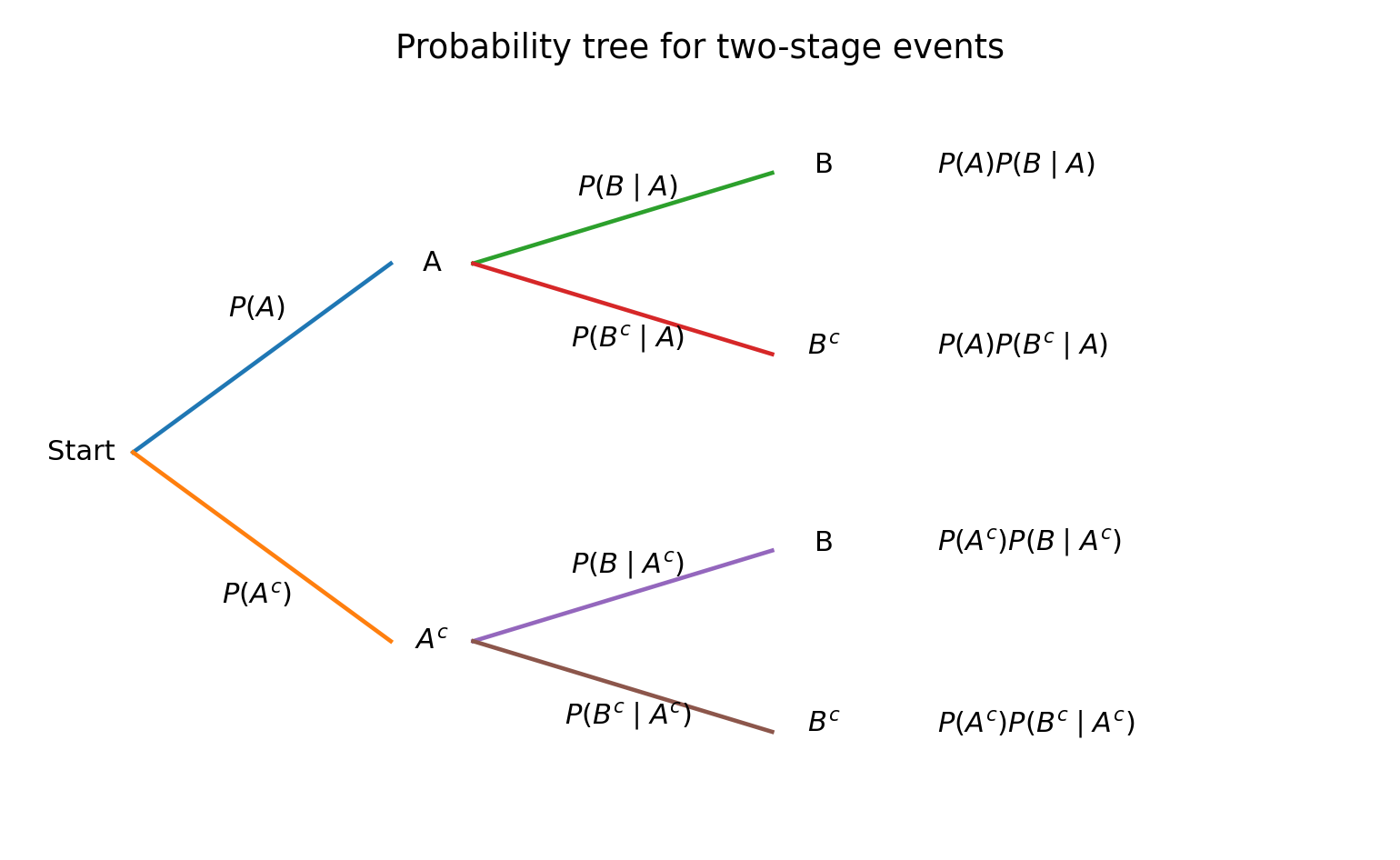
Probability tree for two-stage events
Law of Total Probability
If form a partition of and , then for any event ,
Example 4.3: Damaged goods
A company receives 70% of its goods from supplier A and 30% from supplier B. The damage rates are 4% and 7%, respectively. Then
Bayes’ Theorem
For a partition and evidence ,
Bayes’ theorem combines a prior probability with the likelihood to obtain the posterior probability .
Example 4.4: Medical screening
Suppose disease prevalence is 2%, sensitivity is 95%, and specificity is 90%. Let denote disease and a positive test.
The total probability of a positive test is
Therefore,
Although the test is sensitive, most positive results are false positives because the disease is uncommon.
Post-Test
- If , and , are and independent?
- A bag has 6 white and 4 black balls. Two are drawn without replacement. Find the probability that both are white.
- A factory has three machines producing 50%, 30% and 20% of output, with defect rates 1%, 2% and 4%. Find the overall defect rate.
- For Question 3, find the probability that a defective item came from machine 3.
- Explain why mutually exclusive positive-probability events cannot be independent.
Selected answers: 1. Yes; 2. ; 3. ; 4. .