The Negative Binomial and Geometric Distributions
STA 211 · Lecture 08
Introduction
The binomial model fixes the number of trials and counts successes. The negative binomial model reverses this structure: it fixes the required number of successes and counts how many trials are needed. The geometric distribution is the special case in which the first success is awaited.
Learning Objectives
You should be able to:
- identify negative binomial and geometric experiments;
- use their PMFs, means and variances;
- distinguish common support conventions; and
- explain the memoryless property of the geometric distribution.
Negative Binomial Distribution
Let be the trial on which the th success occurs. For independent Bernoulli trials with success probability and ,
The last trial must be a success. Among the first trials, exactly must be successes.
The mean and variance are
The MGF is
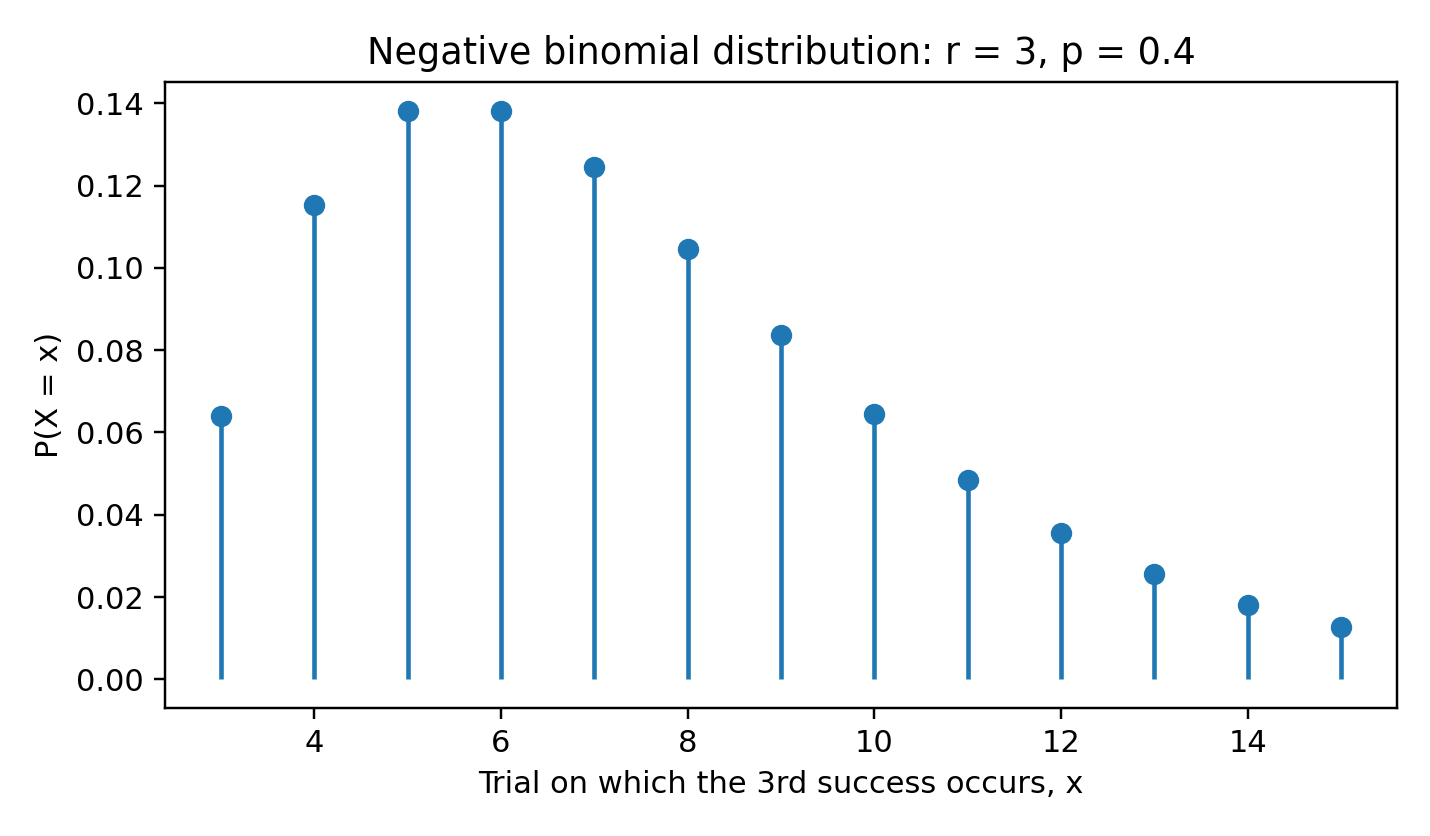
Negative binomial probability mass function
Alternative convention
Some texts define as the number of failures before the th success. Then
with
Always state the convention before using a formula.
Geometric Distribution
For , is the trial of the first success:
Its mean and variance are
The tail probability is
Memoryless Property
The geometric distribution is memoryless:
After failures, the waiting time distribution for the first success is unchanged because Bernoulli trials are independent and have constant success probability.
Example 8.1
A salesperson closes a sale with probability 0.25 on each independent call. The probability that the first sale occurs on the fifth call is
The expected number of calls is
Example 8.2
If a laboratory test succeeds with probability 0.6, the probability that the third success occurs on the fifth trial is
Post-Test
- State the support of the trial-count negative binomial variable.
- If is geometric with , find and .
- Find the mean and variance of a negative binomial variable with and .
- Explain the difference between “trials until the th success” and “failures before the th success”.
- Prove the memoryless property using the tail probability.
Selected answers: 2. , ; 3. and .