The Poisson Distribution
STA 211 · Lecture 09
Introduction
The Poisson distribution models counts of events occurring randomly in a fixed interval of time, space, area or volume. It is appropriate when events occur independently at a stable average rate and simultaneous events in a very small interval are negligible.
Learning Objectives
You should be able to:
- recognise a Poisson count model;
- calculate Poisson probabilities;
- derive its mean, variance and MGF;
- explain its process assumptions and additivity; and
- use it as an approximation to the binomial distribution.
Poisson Probability Function
A random variable has a Poisson distribution with parameter , written , if
The parameter is both the mean and variance:
The MGF is
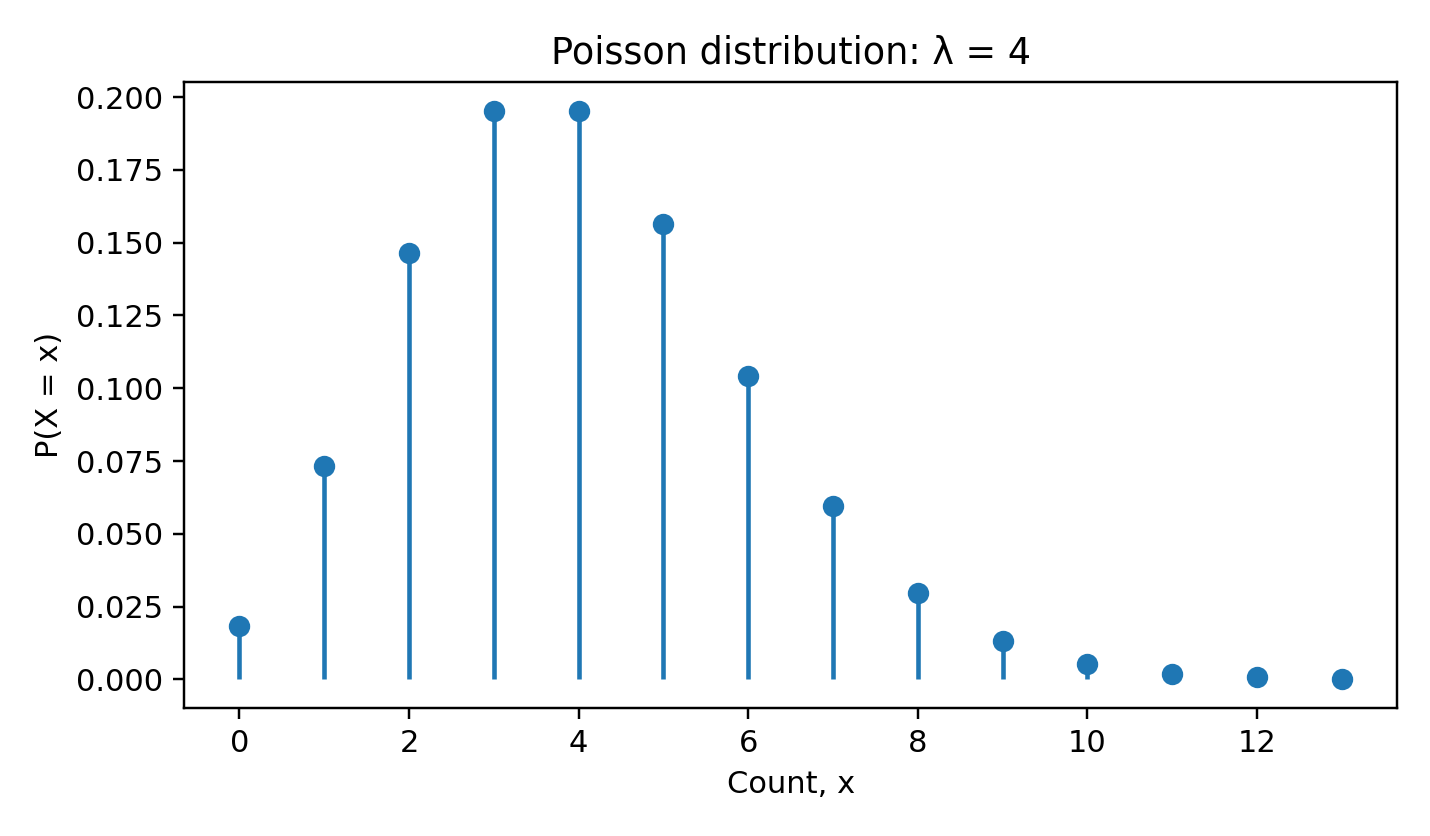
Poisson probability mass function
Poisson Process Interpretation
For a homogeneous Poisson process with rate per unit interval, the count in an interval of length has parameter
The model assumes:
- counts in disjoint intervals are independent;
- the event rate is constant;
- the probability of one event in a very short interval is approximately proportional to its length; and
- the probability of two or more events in a very short interval is negligible relative to its length.
Example 9.1: Calls
A help desk receives an average of 4 calls per 10 minutes. The probability of exactly 6 calls in 10 minutes is
The probability of no calls is
Recurrence Relation
Successive probabilities satisfy
Additivity
If are independent, then
This follows immediately by multiplying their MGFs.
Poisson Limit of the Binomial
If , , , and , then
This justifies the approximation
when is large and is small. A common practical guide is and not too large, though accuracy should be assessed in context.
Example 9.2: Rare defects
In 200 independent items, each has defect probability 0.01. With ,
Post-Test
- State the Poisson PMF and support.
- If , find and .
- Calls arrive at 6 per hour. Find the probability of 2 calls in 20 minutes.
- If and are independent, state the distribution of .
- Approximate for using a Poisson model.
Selected answers: 2. and ; 3. with , ; 4. ; 5. .