The Uniform or Rectangular Distribution
STA 211 · Lecture 11
Introduction
A continuous uniform distribution assigns equal density to all points in a finite interval. It is appropriate when only the lower and upper bounds are known and no value within the interval is favoured.
Learning Objectives
You should be able to:
- state the uniform PDF and CDF;
- calculate interval probabilities;
- derive the mean and variance; and
- transform a uniform random variable linearly.
Density and Distribution Functions
If with , then
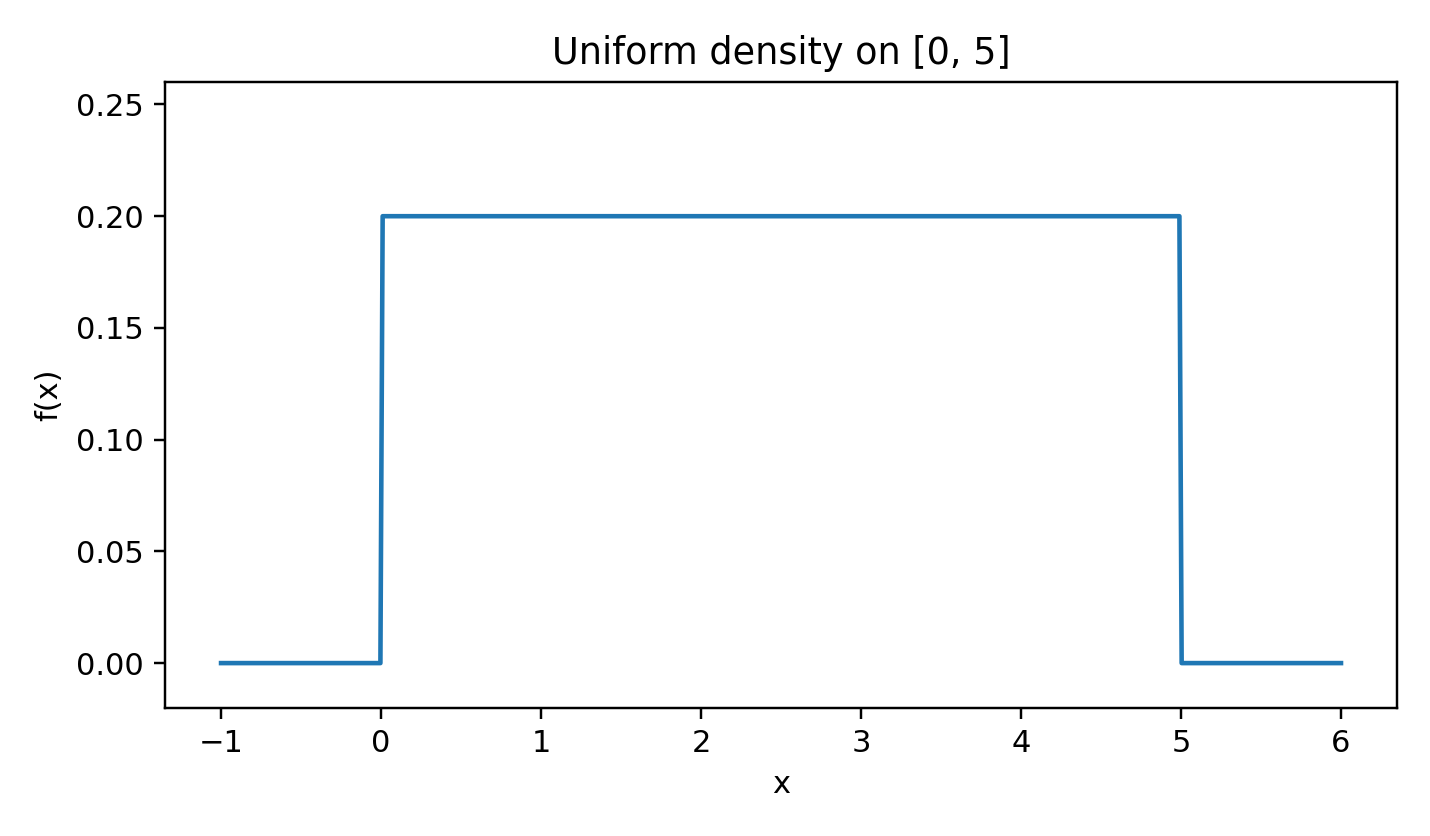
Uniform probability density function
The CDF is
For ,
Probability is proportional to interval length.
Mean and Variance
The median and all central symmetry points equal .
The th quantile is
The MGF, for , is
with by continuity.
Example 11.1
A bus arrives uniformly between 10 and 20 minutes from now. Let . The probability that the wait is between 12 and 15 minutes is
The expected wait is
Linear Transformation
If and with , then
If , the endpoints are reversed and should be reordered.
Example 11.2: Generating a uniform interval
If , then
has distribution . This transformation is fundamental in random-number generation.
Post-Test
- State the PDF and CDF of .
- If , find .
- For Question 2, find the mean and variance.
- Find the 90th percentile of .
- If , state the distribution of .
Selected answers: 2. ; 3. and ; 4. ; 5. .